Cute and informative – what do you think?
Cat xxxx

A very accurate and actually fun visualization of a Borderline mind.
Cute and informative – what do you think?
Cat xxxx
A very accurate and actually fun visualization of a Borderline mind.
Having been inspired by this great post by Life In a Bind, I thought I’d take a bit of a reflection on a great book, and on the concept of memories.

The two are inextricable for me right now because I’m reading Joshua Foer’s bestseller, “Moonwalking with Einstein.” This book is incredible. Just really clean, spot-on journalism on a compelling topic – memory. The book charts the journey of the author from someone with average (i.e. pretty awful) memory who is interested in the topic, through his learning mnemonism (memory training), up to his competing in the USA Memory Championship.
Among all the fascinating information about memory in the book is the following passage which really struck home for me.
Yikes. A bit too close to home? In an age when GPS tells me where to go, my phone tells me contacts’ information, my calendar tells me birthdays or appointments, and Google tells me – well – anything and everything, why on earth would I waste headspace remembering? Yet this passage points out that to truly know something, one must remember it. If information can be said to be externalized (written down or recorded) or internalized (stored in the neurons that make up and control our very consciousness), then it’s clear which kind is more powerful, more meaningful when it comes to the information that makes me who I am.
Consider two widely accepted facts:
1) We think therefore we are. When we say “I” we basically mean our memories. Our memories shape both physical and mental reactions, choices, events and, at our core, self. They make us who we are because we learn (or do not learn) from them. We keep the ones our minds consider essential to ourselves, and, for the most part, discard the more frivolous or irrelevant ones.
2) Our memories are faulty and/or at the very least, prone to some extreme negative thinking. They are riddled with all kinds of patterns and tendencies that mean you will always remember the worst you ever felt, the worst thing you ever saw, the worst moment of your life, etc. The best? Not nearly as likely. As numerous studies have confirmed, when it comes to “memorable,” the more lewd, awful or violent, the better. Mary Carruthers notes that memorization techniques have, for thousands of years, relied on grotesque and disturbing images to make things stick because that’s how easily the memory gravitates to things that stand out as objectionable or horrific to the mind.
Now back to us and our BPD.
If you struggle with BPD, depression, anxiety or all of the above, you know that your memory is even more prone than the average human memory to focus on the bad and inadvertently filter out the good. For me, often when a good memory arises or is being made, I just breeze over it as, “that’s nice, ANYway, moving on…” – or worse, I’ll do the classic, “well this is nice but of course it’s going to go sour soon, just like last time…” – thereby reinforcing my mind’s iron grip on bad memories over positive experiences.
This is why if you believe your memories make you everything you are today, you couldn’t be more wrong. Your memories need your active help to remain balanced and factual. So I’m going to start doing some work to make and retain positive memories. I know lots of people keep a gratitude journal, and maybe that’s where I’ll start. But more than that, I want to internalize the things that make me hopeful, happy, encouraged and inspired – because I know I certainly don’t need help remembering the opposite events. It makes it a lot more palatable to me (and a lot less hokey) to think of this as memory work rather than “positive thinking” or some other fluffy concept that I don’t really feel comfortable clinging to. I really want to know the things I’m happy about and carry them within me, rather than just be reminded of them from time to time as I drag around my bulging suitcases of traumatic memories. Wish me luck!
Cat xxxx
This week my individual therapist was really down on the BPD label. More than usual, I mean. She has always been against mentioning it at all, and I must say I found (find) it quite annoying that I can’t even say it in therapy without her jumping all over it as a dangerous and self-damaging label.
 I was somewhat proud of myself for speaking up this week and explaining that actually, I have found the label very helpful in that it gave me at least somewhat of a path to follow amidst a forest of mental health issues that I just never understood. Without knowing about BPD, I had so little knowledge of why I did the destructive things I was doing, or why certain triggers existed for me. And most importantly, by learning about BPD, I found this online community that actually understood everything I was going through – something I had NEVER experienced elsewhere.
Anyway, Ms. Therapist argued that even bringing up BPD at all = falling back on a lame excuse for the actual behaviour, which is the part that has to change. It also (she claimed) creates stigma, even in your own mind, that you are somehow different, deficient, flawed etc.
I see her point but at the end of the day, I think the label has been more positive than negative for me. What about for anyone else? Have you found BPD gave you an unhealthy sense of identity or bondage to the label? Or have you found it helpful in getting treatment and understanding yourself better?
Cat xxxxx
So often I think the key to living life with BPD is to just untangle (or avoid) as many messes as possible. If I avoid so-and-so, if I don’t talk to what’s-his-face, if I move and change jobs and ignore my family, etc. etc. THEN I’ll never turn into crazy BPD person. How many times have you had the “I’ll change my name and move to another country and re-create myself” fantasy? How about the one where you go live in a cabin in the woods and commit to being a full-on hermit? They’re some of my favourite fantasies when I just feel like my life is too fucked up to fix and I can’t face it anymore.
The truth is that life just is a bit of a mess and it always will be. If it’s not, chances are you’re not really living. When I think back to times that everything has gone as smoothly as I could possibly make it go, they were really boring times. Really boring. No deep relationships. Lots of boring work of some kind or another. No important responsibilities or goals or happiness or despair. Just smooth going. Those times pretty much fell under “subsisting” rather than living.
I know it’s obvious that the “cure” for BPD is to learn how to face these tangles in life, not avoid them. But I at least want the control of choosing when I’m going to come across a tangle, and of course I don’t even have that option.
Right now I really do my best to avoid “drama” – I mean unnecessary crap that involves gossip or fights or whatever. But regardless, some stuff comes up that just makes me feel about 14 years old and want to shut out everyone all over again rather than be dragged into the messiness that is normal life.
One of my closest female friends has had a torch for this guy for several years. As of this week, he has declared a bit of a torch for yours truly (?!). Now this is just classic. Welcome to my life. I try to get on my own two feet, have therapy, be okay, hold down a job and whatnot, and interpersonal stuff just flies up in my face being like, “ha HA, you thought you outgrew it, didn’t you??”
a) I am terrified because I actually sort of kind of think I like this guy back and I swore I’d never date anyone again after my disaster relationship five years ago (gahhhhh but he is so sweet and cute, you don’t even know *becomes giggly child about this*). b) I am terrified of losing this friend or hurting her; I really care about her and her friendship and I don’t think I can handle being rejected by her over this guy. c) This whole stupid roommate situation is STILL ongoing, which means I’m living at my parents’ place (!?) and feel like an out-of-control, unstable teenager already.
So. Messy. So. Frustrating.
What do you guys think? Do you try to avoid drama as a rule, or do you embrace it and find that you grow through these experiences?
Cat xxxxx

OK I realize this is going to be a really ironic message for the medium (or vice versa or whatever), but I’m interested to know: who here actually feels the Internet makes them happier?
I guess those are pretty broad terms – what I mean by “Internet” encompasses social media, any and all information that can be found online, and the various forms of technology used to stay (supposedly) more in touch in our modern world. “Happier” = more mentally healthy and happy than one would be without it.
I ask because I’m very much of two minds about this. On the one hand, there’s no denying that my phone and computer give me a lot of validation and genuine enjoyment via lots of different things – this blog, for example. I get so much out of “meeting” people online to discuss BPD and/or general mental health and/or a million other topics. But particularly in relation to BPD, I’ve never actually met any people in my “real life” who can even begin to relate the way thousands can on here. That alone gives me a very concrete, real-life feeling of being understood, accepted and cared for.
On the other hand, I’m becoming increasingly aware of how much computer/phone usage can negatively impact my mental health, and you don’t need to rely on personal experience to tell you that it’s not a one-way ticket to fun and happiness. Approximately a billion studies now document how many of the venues and technologies that can laughingly be described as “social” are, in fact, isolating, depressing, anxiety-inducing and destructive to our overall wellbeing.
I mean you don’t need to be a scientist to see that sitting on your ass, hunched up and squinting into a virtual reality isn’t healthy for the average human brain or body.
And you certainly don’t need a degree in psychology to realize that escapism is at the heart of the issue here.
Computers offer an escape from many things and into many other things. The realities they offer are still realities – and choosing those realities over dangerous (or even fatal) behaviours is obviously a fantastic choice to be able to have.
BUT it turns out we’re not very good at knowing when to put down the escapist realities and face the ones that make up our daily lives. For example, no one knows better than me how easy it is to write/”talk” about things on the Internet that I never, ever talk about in real life. Am I improving my ability to (eventually) talk about them by writing all this? I’m not sure. But I feel like the answer is no. All I’m really doing is finding ways to avoid doing what I know that I should (wow, was that even a sentence?).
Other classic Cat moments that make up my “Internet vs. Reality” problem:
1) I’m too scared to apply for jobs and move forward with any kind of a career, so I douche around wasting time by researching a million options – thereby overwhelming my brain and achieving fuck all at the end of a long, stressful day.
2) I’m too scared to talk to the people in my life who could be there for me if I let them (granted some of the trust issues I have are the result of their behaviours), so I talk to online people instead.
3) I’m too scared to commit to something big like writing a novel, so I read/write cheap Internet crap instead.
4) I’m too scared to actually make a decision or address a problem, so I text or message about it, endlessly and pointlessly, with people I know.
5) I’m too lazy to get off my ass and actually work out, go for a walk, enjoy a positive activity – so I fool myself into thinking that researching fitness or looking at beautiful trip spots, etc. is somehow remotely as helpful as the real thing.
Quality face-to-face interaction is still the most effective way for our bodies to process those senses of understanding, community, social relations, validation and empathy. And although I’m grateful (SO grateful) for what the Internet offers when a face-to-face interaction isn’t an option, I think I sometimes sacrifice my valuable “real life” time out of fear or just plain laziness. That’s doesn’t really jive with the uphill direction I want my life to be taking as I struggle through this whole BPD mess.
Cat xxxx
How do you go from this…
… to this…

… and survive the kinds of words and thoughts that may even be going through your own mind (don’t feel bad, we’re all conditioned to judge) as you look at those photos?
That was the central question that dominated the recovery phase of my eating disorder. How can I stand not only the horrible attitudes and comments that support my eating disorder from others, but way more so, the ones that come from my own mind?
The two photos above document so much about eating disorders that demonstrate not what is wrong with eating disorders, but what is wrong with us – with people, with the culture that continues to glorify them even as we create token campaign after token campaign of how much we DON’T glorify them (yeah fucking right). Even when I was almost too weak to stand, pale and near fainting with malnutrition, I was forever getting compliments on my physique. One girl I knew said she was getting compliments right up to the day she checked into a hospital.
There is nothing wrong with the bottom picture, except that it could never be used to sell anything. There is everything wrong with the top picture. The top picture represents someone (according to the young woman herself, Mischa Barton) drowning in the midst of a mental health crisis. The bottom picture is a normal human female leaving a store with a beverage. Except suddenly, when you put it next to the top picture, it isn’t just that is it? It’s failure. It’s worse. It’s fat. It’s older/uglier/pastier and, in short, REALER than the top one. And no one wants to see that. “Real” is a hard sell.
In this way, comparison weaves itself into our cultural psyche and ingrained behaviours, subtle and insidious, until it’s everywhere – until the “better than” part does not even have to exist in order for us to hate the “worse than” part. How many times have you been down on yourself for not being more like something (or someone) that doesn’t even actually exist? Maybe you even consciously know such a thing doesn’t exist (i.e. a thinner or younger you). But you STILL compare yourself to it.
But what if the two pictures above were not the only options for someone dealing with an ED? What if there was a third picture to look at?

Maybe it’s just because I personally find babies cuter than Mischa, but that’s my favourite picture of the three.
Both of my miserable outlooks regarding my eating/body depended on punishing myself to some degree: either with starvation or with self-loathing. It took me a rather embarrassing amount of time (try almost 20 years) to realize that self-compassion was the only way out of the miserable dichotomy I’d fallen into.
Self-compassion meant focusing on how I felt rather than how I looked. It meant accepting the fact that my body and I are in this together for the long haul – not for the next month or year – and how I treat it will eventually catch up with me. It meant realizing that even when there are plenty of reasons to dislike myself, I can’t afford to crumble and give in to them – because who’s going to be able to hold me up if I’m not even in one piece?
So I let go of the cycle and focused on self-compassion instead. Eating what I wanted/needed, whenever I wanted/needed it. To say it was excruciating is an understatement. An anorexic’s worst nightmare: for three years, I gained weight regardless of how healthily I ate. My naturally quick metabolism was shot – I doubt I’ll ever fully get it back. But when I consider the decade of abuse I put my body through, it’s kind of a miracle that it ONLY took three years to satisfy itself that yes, I was done starving, and yes, it could stop clinging to every calorie I gave it.
This period (as demonstrated above in the pictures of Mischa Barton) is a necessary and unavoidable (not to mention ironic, of course) part of ED recovery. Many never commit to recovery because they can’t stomach (no dark pun intended) the idea of this part of the process – and it took me a few tries to really “commit” to gaining all the weight. Like so many aspects of mental illness, trust becomes key. Trusting in recovery, trusting in hope, trusting yourself.
Over the course of my slow recovery from anorexia, my BMI rose 10 points in three years. If you’d told me that prior to the experience, I would have been flat-out dead sure I could never, ever survive that – surely I’d go mad, kill myself, hurt myself, fall back into old patterns, etc. etc.
But – oddly enough – I didn’t.
In this way, I really do cherish my ED experience. I know that sounds weird. But it gave me some idea of what mental health (versus mental illness) looks like. It gave me some hope that just because I believe something – even when I’m so certain of it that I feel it as a “truth” deep in my gut – does not mean it is true or has to be true forever.
Now, although I struggle on a daily basis with BPD, I don’t consider anorexia to be a part of that struggle any longer. It’s a pretty amazing feeling to have at least one aspect of this multi-facted demon ‘crossed off the list,’ so to speak.
And did all my hope and trusting myself pay off? Yes. Today I am back at a BMI of 20 with a new appreciation for food (EVERYTHING tastes good when you know what starvation tastes like!) and exercise (feeling strong beats feeling skinny by about a billion miles). My metabolism is quick enough that even when I go a little nuts at the holidays or on vacation, I don’t gain weight. My body knows that I won’t deprive it again so it’s stopped craving calorie-rich, unhealthy foods and/or holding on to every pound for dear life.
If you’re struggling with the daunting task of weight gain as you let go of an ED, know that it will get better. Focus on how you feel and I promise your body will thank you for it – even if it takes years to become apparent. Are you willing to cultivate patience in order to give yourself a better life, a better body, a happier soul?
Cat xxxxx
p.s. This post is, as usual, enormous so I don’t want to weigh it down (GOD, I’m full of these horrendous puns today) even more with specifics but if you have any questions or would like any further information about diet/exercise tips for ED recovery, I have quite a bit of experience by now so please feel free to message or email me. 🙂
Continuing with the theme of Eating Disorder Awareness month, I just want to talk a bit about how unbelievably stupid EDs are. Like, seriously, completely, 100% stupid. It’s shocking how many people who could otherwise be called just about every version of smart can fall prey to the insidiously backwards logic of EDs. I know because I had one for over 10 years, and I am truly fortunate to be able to say that I don’t have one anymore. I have never visited a treatment facility or had any actual/medical treatment for my ED, so I think it’s a story worth sharing.
It began with a compliment. I know that seems odd, as most people seem to set off in a quest for thinness because they are made to feel ashamed of their bodies. Not me, I like to stick to what I’m already good at, guaranteed to succeed.
When I was 13, another girl made a comment in the gym class changing rooms: “Whoa – you are sooooo skinny.” She made the mistake of saying it in a tone that conveyed nothing but admiration and respect. And as many of the girls in the room began nodding their heads in agreement, I felt like a door opened up to something I’d always wanted and never found: acceptance. Here it was. Years of being bullied for my personality and behaviour made me absolutely ravenous for that sense of acceptance which is already so important to any kid that age.
I was really skinny, there was no denying it. I come from a uniformly skinny family. But I’d never realized that some people found that admirable – attractive even – wtf??? OK, I figured: If skinny was what made me admirable, then I’d get even skinnier.
It’s incredible the ways you adapt, the subtle implications that humans use to navigate each other. I quickly noticed that being skinny seemed to convey some kind of appealing vulnerability – it made me, literally, little. And “little” brought out a protectiveness in people that I could fool myself into thinking of as caring about me personally. Being skinny also made me physically frail, weak, tragic, victimised – all the things I already felt internally but didn’t know how to express. Well now I could express them. And I could do it in a way that actually made other girls envious of me. Win-win all around!
Except not, of course.
90% of the time that I was restricting my calories, I was struck by how easy it was. I’d imagined it being so much harder based on how women always talk about the horrors of dieting. I was delighted by my self-discipline – until that other 10% kicked in.
That 10% was, of course, my body’s survival mechanisms, firing on all cylinders, making me have insane cravings, dreams about eating, obsessive thoughts about food that make you feel like you’re going nuts.

Just so no one is under the impression that there’s anything remotely glamourous about anorexia (despite what willowy celebrities and their fashionable rehab trips would have you believe), here’s what it’s like to be a functioning anorexic.
In those uncontrollable 10%-of-the-time states, I became, quite literally, like a starving animal. Almost all rational, higher thinking shut down and I would be unable to stop myself from eating. I kid you not, at times, I walked by unfinished plates in the school cafeteria and was unable to resist grabbing the food from them, running to the washroom to eat the crusts that other students had left. I have heard accounts of how when people get hungry enough, cannibalism becomes possible because the parts of the brain that register emotions (disgust, namely) about what you’re doing basically shut off until you get nutrients. As an ex-anorexic, I can say that does not surprise me at all.
Your emotions go haywire in ways that you refuse to associate with your basic need for food. Everything set me off. Everything was hurtful, personal, insensitive (this was ON TOP of the BPD – yikes). Everything made me want to scream and cry, or even have to cut. In this way, the self-harm and the anorexia went hand-in-hand for me: the less I ate, the less emotionally stable I was (= cut), but the more I DID eat, the more I’d punish myself by cutting. The whole thing came down to a lot of cutting, basically (a lot of which, however, had nothing to do with anorexia). Even now my arms are a patchwork of scars that I hate, although they do fade with each passing year.
You hate your body and your body hates you right back. You’re constantly cold, exhausted, beaten down by the simple movements of a sedentary day. You sleep endlessly and never feel rested. You take a crap once a week, tops, and become chronically constipated (sexy, right?). In your quest to be “attractive” (i.e. thin), ironically, your hair, skin, nails, and even your eyes are sacrificed – they all look awful: pale, dry, papery, dead.

But the worst part is the mental cycle you’re trapped in – the well-documented struggle anorexics face in both loathing and obsessing about the same thing. And of course, unlike drugs or other self-harming behaviours, you know that you can never just cut food out of your life. No matter how anorexic you get, you need to eat something – you know that sooner or later, you will have to to swallow the thing you hate. In this way, it’s a perpetually miserable situation that only has one outcome: lower and lower self-worth, deeper and deeper self-hatred.
When all you’re measuring yourself, your happiness, your value by is how much you eat, you begin to realize that you only have two options: get fat (i.e. get better or at least subsist), or die (i.e. “succeed” according to your inner anorexic voices).
Get fat or die. Get fat or die. Get fat or die. The choice circled my mind endlessly. The only answer was despair, in either case.

Like most long-term functional anorexics, I found myself trapped in a cycle that demonstrated those two choices in less extreme versions. I’d starve until I came close to literally collapsing or otherwise being ‘found out’ (BMI of around 14 was my ideal range), then have a ‘relapse’ into having to eat, gaining 10 pounds or so until I was disgusted with myself all over again… and plunged right back into the cycle.
This went on for 12 years. 12 fucking years (GOD, it depresses me to think of that). Sometimes, in my “it’s okay to eat for a while” phases, I’d think it was all behind me. But sooner or later, the weight would always creep back on and I’d have to resort to losing it the only way I knew how. And after all, it’s not like I was alone in thinking this way: it seems that to this day, plenty of prominent magazines, media moguls, celebrities and models rely on deprivation as the only possible weapon against getting “fat” and ugly. Ugh.
The truth is, deprivation never works. Not really. If you’ve ever dieted in any way at all, you know exactly how long and how well it “works.”
No, the key to breaking the “starve and die OR eat and hate my(fat)self” cycle was a third option that I’d never even heard of.
To be continued in Part 2… (it’s a much happier post – please don’t only read this part!!!)
Cat xxxx

Rather than wait for that to happen and end up in the hospital or a holding cell or some similarly terrible/dramatic situation that I knew would only make things worse for me, I asked my doctor to prescribe a very small number of tranquilizers/anti-anxiety-type pills that I could have on hand in case things got totally out of control. But not enough that I could (if I went full-on BPD nuts) take them to “make a point” to myself or others. Just enough that if I really couldn’t deal or find a way to calm down, I could take something to lower the intensity a bit and/or sleep some of it off.
Do you ever feel like all the pain in the world is yours, and yours alone, to bear?
Besides rage/anger issues, I would say the strongest hold BPD has on me is my addiction to suffering. I don’t know what else to call it. It’s an addiction in the sense that I can’t picture life without it, I don’t know who or what I would be without the portion of pain I keep hanging onto, and I don’t know the first thing about getting rid of it. I don’t even think it can be ‘gotten rid of.’
It’s as if the grief of every parent who has lost a child is deep in your gut; the broken heart of every desolate lover flooding your chest; the pain of every tortured lab animal pulling your nerves to breaking; the shame and self-hatred of every rapist and abuser eating its way out of your stomach.
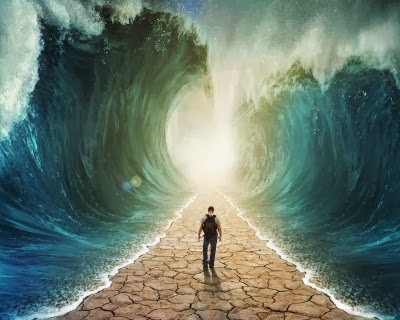
I think of Moses and the Egyptians, luring them into the ocean to drown as God closed it behind them. I often feel like a tiny spot has been cleared of water for me in the midst of the Pacific; the agony of existence in this world is the ocean all around me. I can feel the damp, cool threat of the water, hear the rush of it, know that at some point, it will crash down and swallow me without a trace.
I used to wonder if everyone felt that way. Was I the only one that couldn’t handle it?
My therapist says (there’s a blog title right there…) that people with BPD have a poor sense of self and no boundaries, so the walls that should be there to protect us from others’ suffering are not. We take on the burdens, the worries, the pain, the memories, the traumas of other human beings the way other people pick up style tips.
I’m not sure I buy that. I’m sure that I do have boundary issues and my mental/emotional walls need to be better defined. But I can’t help but weep for griefs that are not my own – even though sometimes they are all tangled up with mine, almost as if it’s only “okay” for me to cry for myself as a side note to someone else’s pain.
Long ago I stopped crying for the pain. It’s only within the last year or so that I could start again. It feels like trying to empty said ocean with a teaspoon. I don’t really know how to feel about the truth that I know in my gut: Life is pain. There’s no exorcising it, no releasing it for good, no total healing, no ultimate catharsis, no leaving it behind. Not really. Our choices are to live with it or to not live. That choice is a lot to bear sometimes.
Happy Eating Disorder Awareness Month!
Not a very common greeting card.
I must admit, I have my reservations about “awareness” as a catch-all concept. Mental health awareness. BPD awareness. Gay right awareness. Bullying awareness. It all seems well and good and I’ll obviously never be ANTI-awareness. But is it actually helpful? I’m just not sure. And my own personal journey with an eating disorder is one of the main reasons I feel this way.
Nowadays, the whole concept of eating disorders is as common, familiar and even (sadly) popular as braces: we all know many, many, MANY people who had (or have) them and most of us either had them at one point or kind of toyed with the idea of getting them. 10 to 15 years ago, when I was a teenager, things were very different. Eating disorders definitely existed but they were not nearly as common and there was a basic understanding that taking things too far was NOT okay.
Now bring in the awareness movement. Everyone listen up! Eating disorders exist! They are NOT okay!
Huh. Well. We all knew they weren’t okay. And it’s not harmful to clarify that or raise the topic to give some people affected by it a sense of community.
However. Awareness is a double-edged sword. The more you spread the word… the more the word spreads. Suddenly, what had once been the domain of a few was no longer a secret at all. Suddenly, the “secret” went from being a strictly dark one to one that was getting A LOT of light and attention. Website after website sprung up promoting “thinspo” (fucked up pro-anorexia or pro-bulimia propaganda). Celebrities gave tearful confessions in droves – and for every sob story they told of being so anorexic they made themselves cold on purpose to increase calories burned, you can guarantee 100 girls only heard one part of the message: “Extra cold means burning extra calories.” I know that the more I learned/heard about anorexia, the more anorexic I got. The more tricks I learned, the more I internalized the lesson “This is what gives me my identity, this is what gets me noticed.”
Do you see what I’m getting at? While I have no problem at all with awareness campaigns in the sense they are meant to be taken, it must be acknowledged that there is always another way of taking them. Bringing awareness to a topic puts it in people’s minds. That’s the point. But depending on the topic, that is not always a positive thing.
Consider the following:
The National Eating Disorders Association started in 2001 as an amalgamation of two existing eating-disorder awareness societies. Basically, in the late 90s, EDs started to get big-time serious attention because people felt eating disorders were becoming dangerously prevalent and should be addressed. Now let’s look at some pop culture female icons of the 1990s:
Anyone remember these ladies?

Or these gals? (side note: marry me please, Joss Whedon)

Or this famous dynamic duo? (side note: godDAMN, Xena is a fox)

Now flash forward to the pop culture icons of millions of teenaged girls today:

Huh.

Oh dear.

Well, thank GOD we became aware of the problem before the idea of skinny = pretty completely took over the media, eh? Oh wait… yikes.
Our current approach to ED awareness is clearly not working.
I’m not saying the answer is shut up about it already. But unlike cancer or MS or many of the other diseases with big ‘awareness’ campaigns, mental diseases are often adopted as coping mechanisms for extremely difficult circumstances. So they only cloud the water, so to speak, and often fuck up an already fucked-up situation by taking attention AWAY from the actual problem. What are the odds those problems would be better addressed by focusing on them rather than on the coping mechanisms people develop for them?
Specifically, eating disorders aren’t about eating (duh). They’re not about bodies either. They’re not about weight, measurements or calories. They are about inner self-loathing and an unmet need to be accepted/loved. The body is simply an outlet for the actual problems inside. Obviously. So why exactly are we putting so much effort and attention into the outward signs of what is actually a deep-seated and extensive societal problem affecting us all?
The core problem is self-hatred. The core problem is feeling afraid, of feeling like life is scary and beyond your control. The core problem is isolation, feeling cut off from others and any sense of community. The core problem is “I will do anything to stop this feeling.” It can be stopped in a billion ways: drugs, drinking, OCD, eating/body image disorders, anger issues, etc. etc. etc.
We’ve wasted decades already focusing on the wrong problems altogether. I just think we need to be doing a lot more to address the actual human needs and fears – as uniting factors that affect us ALL – rather than putting so much time, energy and money into addressing each little specific branch of a massively fucked-up tree. Know what I mean?
Cat xxxx
Life after Borderline Personality Disorder; making a life worth living through love, laughter, positivity and Dialectical Behaviour Therapy
Functional Borderline
Home of Abundant Inspiration
WeeGee navigates the big C
Inspiration for those with Mental Illness
The immeasurable terrors of her mind...
Ramblings from a crazy, cluttered mind...
A journey through therapy
Hope Heals.
 Half of a Soul - Life with BPD