*Warning: Triggering as fuck. Do not read if you are in a not-so-great place either.*
I really should have seen this coming.
The Christmas/New Year combo is a double-whammy for me and always has been. Both are dates when you really can’t help but reflect on where you are vs. where you’ve been vs. where you wanted to be at this time of year. Both are dates that involve an absolute overload of warm fuzzy feelings and happy families and fond memories and joyful hopes.
Unless you don’t have those things. Then the whole fucking season is a reminder of why you should just give up and save yourself – and others – a lifetime of pointless struggle.
I was feeling sort of hopeful about my recent therapy (and therapist). Then our last pre-holiday session was an absolute disaster. As in, “Let me talk about myself for an hour and not even realize I’m triggering/upsetting you and not helping AT ALL by bringing any of this up.” For me, strong emotions always = numbness and shutdown now, so I was seriously dissociated by the end of the day. It got worse and worse until I flipped out on my roommate, smashed my phone, trashed our house (smashed pictures, dishes, etc.) and left for my parents’ on Christmas Eve feeling like I usually do after I let myself feel any of the pain and anger I usually numb myself to: a monster that needs to be put down. Got to my parents to find my roommate had, in a state of terror, told them everything. Told them they needed to monitor me because I seemed suicidal. Which I was. But I was furious at him for saying anything and I still am and I can’t help it.
What the fuck is wrong with me? It’s all I can think when things are like this. I get back into the cycle of questioning why I’m like this, why it never stops, why I keep thinking anything will change… the answer, deep in my gut, is always the same: it’s you, you’re the problem, you will never change, and you’ll be saving everyone so much pain if you just end it.
I feel like such a horrible thing, such an ugly shell of a human being, and like the grain of humanity that I cling to is being warped and twisted with each passing year into something I can’t live with. I’m right back where I started – except not, because I feel lower than ever knowing how many times I’ve felt like this and how each time I thought “well things can only go up from here.” It turns out I was wrong every single time.
I don’t feel worthy of anyone’s love or attention and I can’t stand the infuriating, pathetic, childish BPD tendencies I have to demand both when I know no one in their right mind should give me either. The thought of hanging on, for years and years, a burden on my loved ones and the hospital/health care system with my increasingly dramatic, self-harming attempts for attention makes me feel sure I would be doing the right thing by giving up now.
Why do we bother when we feel like this so often? Where is the upside of any of this? I can’t see it even though I know parts of me really want to and have tried so hard in the past.
Recently, I posted about a “holy crap” moment I had in therapy. Specifically, part of me – the main part of me, in fact – finally got it. My uncontrollable reactions to (real or perceived) abandonment are the result of abandoning myself. Invalidating, neglecting, suppressing, and disliking myself. It’s kind of a big deal.
Note that this is a perfect example of why therapy is 100%, no exceptions, totally and utterly necessary in the treatment of BPD. It’s not one of these things that you can read enough about, think enough about, write and feel and draw enough about and then deal with it yourself. You’ve done that for years, and this is how it’s gone, i.e., terribly. You need perspective. Why not from friends or family? Well, gee golly, let’s look at the nature of BPD and how things usually go when you get into the nitty-gritty close feelings with friends and/or family. No. Too close, too personal, too much potential for a blow-out. A therapist keeps things distant and professional enough to be tolerable and controlled, but is ideally close enough to be honest and helpful.
What I’m about to post about is kind of more “holy crap” realization stuff. It’s not necessarily specific to BPD either. It applies to every person on this planet and the way our brains work.
Here is what I’m learning and understanding.
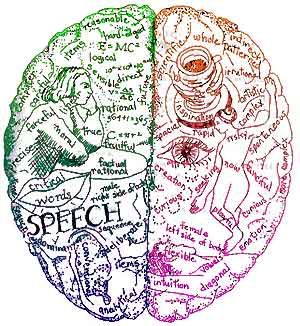
We all have “parts” of ourselves. Maybe some parts are mean, scary, angry, and other are popular, funny, witty, confident. Parts come to the forefront and parts recede to the background when not in use. That’s normal. That’s the brain. For most people, those are what we know as “moods.” As our control group, let’s use “Bob” as our standard, relatively well-adjusted person. Bob has happy moods, sad moods, good moods, bad moods. To an extent, they determine his perspective and behaviour; e.g. when he’s in a bad mood, things look blacker and his behaviour is grumpy. But the key thing is: Bob’s moods have a direct and immediate cause. A mood comes into his frontal lobe because something within his awareness and control made it come forward. Someone cuts him off in traffic, and here comes an angry mood. Later his brain carries out the logical thought process that it’s just traffic, it doesn’t matter and it does not affect his long-term wellbeing. So the brain releases that mood and it goes on its merry way, returning him to whatever stable state is his “normal.”
Now let’s consider Cat (I know, I’m so creative haha). Cat is our BPD representative. Cat does not have moods. Cat has disaster pockets. Why? Because Cat’s brain is divided by stone walls into its different parts, whereas Bob’s was a flexible and well-tuned system of connections and receptors that communicate well with each other. Cat’s brain has cut itself up into little parts, so to speak, because that was how it coped, for years, with difficult feelings/states. Embarrassment? That goes into a locked box. Grief? That’s going into a locked box. Traumatized by some event? That’s definitely going straight into a locked box. This is how the brain has “coped” with things it could not handle at the times that they happened. Good job, brain, you did help Cat get through years of difficult circumstances. You helped her not have to deal with things that felt totally overwhelming. HOWEVER… they’re still there, and they’re never ever going away because being locked up is keeping them just as present and just as strong as they were when they first happened. And that’s killing Cat from the inside. A divided self is not an okay self. And brains like this are divided into parts we like, parts we hate, parts we don’t get, parts we’re disgusted by. Is it any wonder that borderlines often feel like they have no identity or that they’re made up of tons of drastically different people?
The rest of the brain doesn’t communicate with the hurt parts. They are cut off. All they know is the pain they contain. They don’t have adult logic. They don’t have DBT skills. And when they get triggered – WHAM: Cat is right in the midst of them, however powerless, however young, however overwhelmed she was when that original feeling occurred. And unlike a mood, not only do these pockets come without a direct cause (at least not one that makes any sense to anyone who does not know Cat’s intricate system of traumatized brain parts), they also don’t leave naturally. They don’t know how. Cat falls in them and can’t get out because they are so sick of being locked away that they don’t want to leave.
Does any of this strike a chord with you guys the way it hit me?
Wow. The more I learn about brain anatomy/chemistry/composition, the more it is helping me understand every aspect of BPD and its treatment.
Your brain needs to heal itself. No amount of outside help is going to reach the little pockets of pain, trauma, etc. locked deep inside. You have to go in there and open them, and let the healing in. This is the direction that my therapy is now taking. The DBT is a crucial part of it, because it’s the toolbox that you go to work with. I need to have my DBT skills down pat, because I’m going to have to use them and teach them to the parts of my brain that hasn’t learned them yet.
This helps me accept a lot more than I could even one week ago. I feel like the knowledge that this will never be fixed from the outside is sinking down, down, down through layers of my brain and myself, and is now reaching the depths that mean I finally get it. Even if someone wanted to, they cannot “force” my mind open. They cannot communicate with inner me. That’s like saying they should learn things for me so that I understand them. It just doesn’t make sense.
My therapist told me that once you start this process of peeking in the boxes and healing what’s inside, you will be amazed how quickly the healing process picks up speed. I don’t want to get too hopeful, but I can see why. Every day it’s like new stuff is falling into place, making the whole picture clearer and clearer. Things that don’t even seem related are starting to be affected by what I’m learning. For example, by focusing on this – my mind, my parts, my inner voices and thoughts and boxes (not that I focus too much on those dark boxes yet, that’s pretty advanced and terrifying stuff) – I have inadvertently been a tiny, tiny bit better in dealing with people I normally hate/resent for not caring or helping enough. I didn’t have to try and work at the relationship between us – I just had to start looking into my own mind.
Does this sound too good to be true? Or too optimistic? I guess it kind of is. I mean as I said, I haven’t gotten into the really rough stuff yet. Confronting the locked boxes and doing the necessary therapy to heal them is going to be a whole different story. But just learning more about what the fuck is actually going on in my mind is kind of cool and oh yeah, incredibly validating, because hello self – I AM NOT CRAZY. That’s kind of been the best realization thus far. I hope it doesn’t totally evaporate when I hit a rough patch (it will, but I hope it comes back). My brain has been doing an astoundingly clever and difficult – albeit misguided – job: keeping me sane in the midst of insane circumstances. I can see why it did this and how it designed this process and that means…. I am not crazy. Holy crap!
Love it. Awesome article by someone named Carrie-Lynne Davis. I don’t know much about this miracle known as the internet soooo I hope it’s okay for my to “re-blog” this in this fashion?
So I went to individual therapy extremely frustrated last week. Not only had my therapist cancelled last week (cue angry abandoned borderline feelings), but recently I feel like I’m getting nowhere concrete. Even though I do find myself able to think of things in a better light most of the time, all it takes is one really horrible day – even one really horrible moment or mood – and I lapse so easily into bad old habits and thoughts: nothing is ever going to work; nothing is ever going to change; something is wrong with me, etc. etc. I decided I was going to try and be up-front. By which I mean I wasn’t going to lose it, but I wasn’t going to mask my every emotion and self-invalidate by saying everything was fine. Here’s how my initial dialogue with Karen went:
Karen: How are you?
Me: … not great.
Karen: Why, what’s up??
Me: (SIGHHHH) You said you’ve successfully treated borderlines.
Karen: Yes.
Me: How? What did you say? What did they do? How did it start? I want this to stop and I feel like all I’m learning to do is adopt some relaxing breathing techniques that pussyfoot around the actual problem.
Karen: What is the actual problem? The “I hate you, don’t leave me” intensely irrational feelings?
Me: YES. Exactly. That. I don’t want to feel like that. I don’t want to think of that as the real me – this crazy bitch who flies off the handle when she perceives the slightest invalidation or abandonment.
Karen: Why do you think you’re so sensitive to those things? Why do you think you’re so prone to feeling abandoned?
Me: I don’t know… I’m pathetic and needy?
Karen: It’s time to come to the core of this. It’s because you’re abandoning yourself.
Me: No, that’s not… wait… Whaaaaaaa????
Karen: You have emotions. You just called yourself pathetic and needy for having them. You just called yourself a crazy bitch for having them. You’re not even there for yourself; your logical conclusion is, why would anybody else be?
Me: *stunned silence*
Whoa. That conversation, and particularly that phrase, really hit home. REALLY hit home. I’ve been turning it in my mind for days.
You are abandoning yourself.
Do you ever get that goose-bumpy feeling when words really resonate because you know, deep in your gut, without having to analyze or intellectualize it, that they are true? That’s how I feel when I think about that phrase.
You are abandoning yourself.
It was like a veil – or at least a corner of a veil – had been pulled back. I’m working on self-validation and all the DBT stuff that I should be – but I’m so far from genuinely knowing how to “be there” for myself. When I’ve been angry at people for not meeting my crazy expectations, I’ve said hollow things like, “Forget about it – you can’t fix me.” But I didn’t mean it. I never meant it. What I desperately wanted was exactly the opposite – someone to mend all my internal chips and cracks. It never worked. It never would have worked. I know this, but I didn’t know it – not really, not deep down. Now, I feel like I’m starting to get it at last.
You are abandoning yourself.
As far as I can tell, it’s not like half of me abandoned the other half. It’s more like, most of me abandoned certain parts I didn’t like as I got older and gained the ability to control (i.e. suppress) my emotions.
When you have emotions as intense as those of a borderline, its not hard to see why you’d abandon them. They’re the reason people (horrible people anyway) attack you. They’re the reason you can’t live up to the expectations you’ve set for yourself – or that other people have set for you. They’re the reason you feel weak, stupid, abnormal, ashamed and vulnerable. You start to think that the people who invalidate you are right – after all, who would want to put up with someone so contrary, so needy, so difficult to control? As a result, the older I got, the more I separated from the parts of me I couldn’t handle.
When I was 8-10, I was only (“only”) suffering stuff like random anxiety and trichotillomania. By 11-13, I was pushing into kleptomania, anorexia and self-harm. But then something happened over the next couple years, to my total surprise, that I could never explain until now: all of those outward manifestations of pain started to disappear. It seemed effortless. I never needed help with them. They just left. It just happened. Numbness set in instead.
Now I realize that Grown-up Cat got bigger and stronger than Child-Cat. As most of me matured, I got the upper hand on the “immature” parts of myself. Success! (or so I thought) No more of that nonsense. Sure it’d crop up from time to time, but only at the very worst times. And feeling numb wasn’t so bad compared to the constant agony of adolescence.
This is pertinent because Karen asked another question that struck hard because I’d never, even thought about it: “How old do you actually feel when you’re depressed or upset?”
The answer came so fast it was startling. For me, it’s about 14. Right about the time I started to be able leave that uncontrollable and suffering part of me behind. That freaked me right out. Mostly because it clicked; it made so much sense in a tragic and horrifying way. She’s still there. She’s right there where I left her, at 14. Abandoned and miserable and all the rest of it – just more and more gagged and imprisoned with each passing year.
And of course, she’s not really under lock and key the way I think she is. When anything happens that elicits a strong emotional reaction – there she is, as I found out when trauma struck in my late twenties. Emotionally, I’m about 14 years old.
That’s a lot to take in. I feel like I’m wading through years and years of unravelled, unconnected thoughts and feelings, trying to put them back together in the right order.
But the main thing I feel is… horrified. I feel shocked and guilty and horrified. For so long I’ve thought of my suppressed emotional self as crazy – in fact, I’ve literally casually named her Crazy Bitch, as I posted just a couple weeks ago. That was what I called the part of myself that could still feel and hurt: a crazy fucking bitch.
Not only did I abandon myself, I’ve been absolutely eviscerating myself, calling myself things that I would never, ever let someone else call me. Treating my emotions like they’re insane. Treating my pain like it’s nothing. Treating my thoughts and desires like they’re wrong and screwed up. Treating a whole crucial part of myself like it’s broken, diseased, and in need of amputation. Holy shit. No wonder this hasn’t gone very well.
When I was a teenager, something happened that immediately came to mind as I thought about this. I was once a big-time diarist. I’d kept all my diaries since I was about 7 years old under my mattress. My little sister and I, much to our constant chagrin, shared a room for most of our lives. One day, I realized my diaries weren’t quite in the spots I left them. I eventually got it out of my sister that she had been reading them. Were the diaries particularly incriminating? No, I had done nothing remotely scandalous or interesting by that point in my life. Were they likely to get me in any trouble? No. But I was so filled with shame and self-loathing, so angry and disgusted at the idea of anyone knowing my true thoughts and inner self that later that day, I dumped them like a murdered corpse and never kept another one. I slowly stopped playing music even though I had loved it for years. I stopped painting or drawing. I stopped expressing anything – pleasant or painful, minor or intense, unless my BPD took over and I exploded. Even now, as I start to slowly edge back into acknowledging and expressing my feelings by writing in this blog, I know that it would fill me with terror and rage if anyone who knows me in “real life” read this.
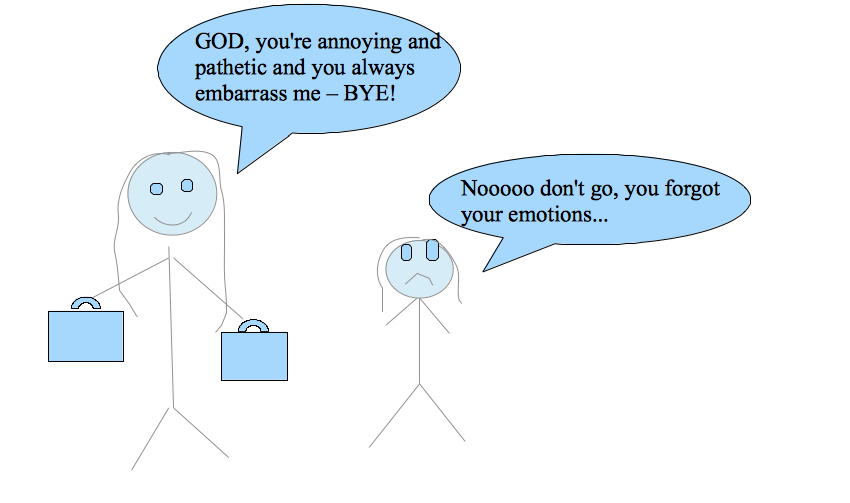
Could I be sending a stronger message to the vulnerable and emotional parts of myself? You’re embarrassing. You’re something I’m ashamed of. You make me feel pathetic. I don’t want anyone to know about you.
I know that based on a lot of blogs I’ve read, borderlines seem to have a really hard time with a fixed identity (as I addressed in an earlier post). This is why. You are abandoning yourself. Some borderlines are so distant from themselves, so ashamed of who they are, that they can’t even voice a preference for a particular type of music or food. You have abandoned yourself. Until you can stand by yourself through good and bad, intense and awful and wonderful and embarrassing and everything that comes with a human being – you have abandoned yourself, and every perceived invalidation from someone else will hurt like hell because it’s only reinforcing what you’re putting yourself through.
It’s hitting me that this is going to be horrendously uncomfortable. I feel ill at the thought of facing my unleashed 14-year-old self, and even more ill at the thought of all the self-love and touchy-feely compassion that’s going to have to happen to make her okay. But honestly, I’ve run out of options. I’ve suppressed and self-loathed til I can’t suppress and self-loathe no more, and it’s never ever worked. I’ve made enemies out of so many people I considered soul mates and best friends that I can’t go through that anymore either. It’s destroying my faith in people and my hope for any kind of future for myself.
I’m not entirely sure about the “how” but the “what” is clear: it’s time to stick with myself and stop vilifying other people for what I’m actually doing to myself.
Because I think it’s pretty important. Not self-important. Don’t get me wrong. What I’m saying isn’t an opinion I want you to agree with or think of as important. Rather, it’s something that I see at the very core of BPD, and I honestly never realized it until now. So if this can provide any insight to anyone else and save them the hours of research and therapy that I went through to arrive at it, I’d be thrilled.
Great (and not-so-great) expectations.
Expectations. It’s kind of a huge and all-encompassing topic and therefore carries the potential to have me blab on about it for pages and pages and pages so apologies in advance in case this gets out of hand. It represents, to me, the Problem with BPD, the issue that I can’t let go of, can’t get over, can’t navigate and just can’t shake even if I can pretend everything else in my life is zippi-dee-doo-dah fine.
Specifically, the expectations that I have of other people – and, more specifically, just those closest to me.
My expectations are frequently, without a doubt, crazy. They are wrong. They are unrealistic. They are totally insane. But if you have BPD, you know how bloody hard it is to even temporarily ignore them, let alone get rid of them. They are always there, just waiting for someone to get close, and the second they do – WHAM, you are transformed into a raving lunatic because so-and-so clearly doesn’t care because they didn’t do this, and they didn’t say that, and they obviously should have done this and because they didn’t you should kill yourself to show them how heartless they are, etc. etc. etc.
You want to shake yourself, slap yourself, shame yourself for being so embarrassingly whiny, juvenile, needy, clingy, entitled, self-centred, and just plain psychotic.
Anyone thinking, “OH MY GOD, I know, right??”
I hope so, because this is really painful and self-abasing for me to type out so I’d feel better about it if anyone at all could relate. It raises points that have to be raised if I’m ever going to get better, but it also reveals a side of myself that I absolutely loathe. An identity that I have always referred to as ‘Crazy Bitch.’
Crazy Bitch doesn’t come out as long as no one is close to her (which is why, coincidentally, at the times that my life was going the smoothest, I essentially had zero close friends). As long as no one is there to unleash her on, she grumbles away, imprisoned and powerless, but growing increasingly resentful until she gets a chance to really shine. As soon as someone seems like they really do care – she is lightening quick, assuming, demanding, jumping miles ahead, ripping down all boundaries (healthy and otherwise), and all the while building fragile fantasies and sky-high expectations of a long and fulfilling future with this person – who, by the way, will obviously telepathically intuit her every need forever. So as long as it all works like that, she’ll finally get what she wants – hooray!
Except it doesn’t. Ever. Obviously. And then Crazy Bitch is really in her element. Shattered hopes are her forte. She takes over everything else about my personality and makes it about her needs, her wants, her oh-so-delicate feelings. Screaming and raving at the person who has done absolutely nothing wrong, she will usually jump straight to hurting them – verbally, emotionally, physically, whatever – and hurting herself to show them just how horrible they are and how much they are the problem and she is just an innocent, downtrodden victim.
Just writing about Crazy Bitch makes me realize why some people have such a deep-seated hatred towards borderlines after being hurt by them.
It all goes downhill pretty fast from there. And then Crazy Bitch has a new entry in her massive catalogue of “Reasons to Hate Life and Everyone” because yet another expectation wasn’t met. It’s why so many borderlines hide behind extreme cynicism and pessimism: we claim to have no expectations whatsoever of life or people, because both are shitty and you can’t rely on them. But don’t be fooled: our expectations are, in fact, higher than just about anyone else’s, higher than the most naïve of optimists.
Before I’d heard of BPD – i.e. for about 25 years – I really believed Crazy Bitch was the real me, which was pretty devastating, as you can imagine. To be honest, I guess I kind of still do believe it a lot of the time. But at least the seed of truth is there now, even if it hasn’t grown into full belief and realization yet: DBT and therapy have helped me to realize that Crazy Bitch is actually a mask, even though she felt so real all this time. How do I know this?
Because everyone I know or read about who has BPD can relate to what I’m saying. Every single one of us is Crazy Bitch when they’re in full-blown borderline mode.
So what’s more likely: That we are all the exact same person deep down, with the exact same reactions and feeling across the board? Or (more logically) that we’re all exhibiting the exact same symptoms of an illness, and it’s dominating and masking our real personalities underneath?
The root of my despair and depression were the incredibly negative things I’d been telling myself to try and counterbalance my expectations, which I knew were way too high and unrealistic to be normal. No one cares, no one loves me, no one understands. None of those thoughts were not necessarily true. What was true was that no one ever cared, loved, or understood enough. And, as Karen pointed out, that “enough” would keep even the best relationships in my life from ever being anything positive because they were only, for example, 99% supportive or understanding (at best!), and not 100% perfect all the time, so Crazy Bitch demanded that I end them or keep them at a distance.
So the “enough” needs to change. The expectations of what other people should or can do to care for me need to lower significantly. But how?
That’s what my therapist and I are supposedly going to be working on over the next couple months.
Step number one is concrete and relatively easy, so I’d recommend giving it a try. Step one involves making a kit – both real and metaphorical, ideally – to satisfy your own expectations.
Picture the times when everything goes to shit. The times when you’re on the edge of (or even in) a BPD frenzy. What do you need? What do you want? Leave other people out of it for the time being. Don’t fall back on the typical BPD “but I’m helpless when I’m upset” answer: i.e. that you want someone to validate you and take care of you. When you refuse to continue the pattern of putting the blame and expectations on someone else, you realize that what you actually want is simply to feel validated and cared for. So: what can you do to make yourself feel validated and cared for?
This is huge. Like, really huge. If this works, this is going to be a massive hit to the hold BPD has on me. If I can learn to actually turn inwards and take care of myself instead of automatically turning outwards when I start feeling awful, that alone will eliminate the majority of the times when I feel Crazy Bitch is in full control. I feel really hopeful about it – so hopeful that I also feel kind of sick and terrified because of, you know, the whole issue with hope/expectations.
But anyway… What about you guys? Do you have any kind of (real or metaphorical) kit for meeting your own expectations? Any tips?
It’s sad that mental illness can be a source of division rather than unity even among families.
Today started as one of those “wake up in the middle of the night and start thinking and never get back to sleep” mornings. Never the best of beginnings. Dream life, and the consciousness that lies right on the fence between waking and sleeping, is such a mystery. Sometimes you dream about things that you thought were long “sorted” and then realize a part of you which you don’t even really know about is working through stuff on a full-time, under-the-table basis. When I first started therapy, I was terrified that it would immediately involve being forced to meet my subconscious self. That’s someone I really didn’t want to get to know any better. Not because she’s necessarily evil or nuts, though she may well be (and often seems to be), but because I can always sense that she is there, dangerously hurt, out of my control, feeling everything a thousand times stronger and deeper than I can stand to think about. For so long, I kept funnelling every emotion I couldn’t handle straight through to her, closing my eyes and plugging my ears as it went past my conscious self. All gone. All better. Oh wait, except not at all. Unsurprisingly, deep and essential parts of yourself become a festering dumping ground when you use this method, a sewer of unpleasant feelings. And when the sewer starts backing up, you’re forced to pay attention.
Which brings us back to now.
At about 5 a.m., I found myself instantly transported from zzzzzz to grrrrrr without knowing why for a full 10 seconds or so. Processing, processing, processing…. oh yeah, that family argument when I wish I’d said that and then I didn’t and now I can’t let it go. WHY am I thinking about it now? Why was I feeling it before I even knew what I was thinking about?
I still have an okay relationship with my family. Which is to say, to all appearances, I have a great relationship with every member of my immediate family. In reality, it usually seems we have terrible, if not non-existent ‘relationships’ in our family. Anyone know what I mean? Based on the fact that BPD seems to have a very typical “breeding ground,” I’m guess I’m not the only one with this kind of background: everything’s normal on the surface, but growing up you often felt things that were terrifying, confusing, painful and horrible, and no one said a fucking word about it. Even when all of it started to manifest as “bad” behaviour that made you feel ashamed and had your parents wondering what on earth was suddenly (“suddenly”) going on with your wacky adolescent self, no one did anything – least of all the caring or validating thing. Emotions were understood through a lens of judgment, criticism and an emphasis on rigid self-control. Real understanding, caring, compassion, or emotional honesty were in seriously short supply. Sound familiar? It was my first two decades in a nutshell.
I used to (and periodically still do) get so frustrated with myself and ashamed of my pain because technically, nothing “that bad” had happened to me. Nothing – at least nothing that I can remember – fit the stereotypical bad childhood that would have allowed me, and others, to easily explain my emotions and resulting behaviour. I was never beaten, mistreated or abused in any of the widely recognized ways. My parents weren’t alcoholics or drug addicts, we weren’t poor, and we were never harshly punished.
It’s only recently that I am able to start the slow processing of teaching myself what I now know to be true: Providing basic – or even perfect – physical care for a child is not enough. If our western society is proof of anything, it’s that. How many well-off suburban kids, raised in a (relative) lap of luxury, routinely grow up to struggle with severe mental illness of one kind or another? All the physical care in the world does not make up for the crucial things that our culture now lacks: authentic emotional health and expression; real community; compassion and validation on a regular basis; genuine caring relationships that we know will always be there for us. The number of people I know who were raised in such an environment could be counted on one hand; you’ll spot them right away because they’re happy, well-adjusted, in great relationships and very successful in some way.
Anyway, rather than go off on a tangent/rant about all that, I’ll stick to the point: my family is terrified of emotions. So much so that even when my life was completely off the rails and I was covered in cuts and severely underweight, nobody said a word. I pulled out all my eyebrows and eyelashes; I got caught shoplifting. Nobody said a word other than, “Don’t do that.” Nobody suggested therapy. Nobody asked what was wrong. Nobody. No screaming fights in my family. No “I love you” either. No crying, no comforting, no admitting that you’re actually having a really, really awful day.
I am the product of this environment, clearly. I have internalized every one of these lessons until emotions are scary, uncomfortable, foreign. I don’t like to be around people who are crying or upset – so you can imagine how group therapy is for me. I hate raising emotions in myself because I have a grand total of zero skills for dealing with them. I don’t know how to exorcise or express them healthily, and I’ve long preferred numbness as opposed to the only other coping tool I adopted for handling them, which was self-destruction of just about any kind. I see my problems and my hurts as constantly in need of someone else’s care and attention, but I believe I’ll never really have it since people don’t care and can’t be trusted to do so.
I honestly would not wish BPD on my worst enemy.
So anyway, I wake up last night thinking of a number of choice remarks exchanged between my dad and my (now adult) brother the other day. No need to infuriate everyone else with them, but suffice it to say they were to the effect of “trauma and mental illness are stupid figments of the imagination and people just feign them to get attention” along with some bullshit about how the government is too liberal in funding their treatment. Offensive, as well as WAY too close to home for me to take it any way other than personally.
Now I know my family and I will never see eye-to-eye on politics and/or religion. That’s just the way it is and always will be, and I honestly don’t think it would matter – if there was a foundation of basic respect and validation going on. I’m willing to accept that you can’t just dismiss someone based on generalizations about the beliefs they subscribe to. Do I get the same basic courtesy? No. Do I say a fucking word about it even though I’m seething? No. I sit there and pretend I can’t hear it. I sit there and pretend I’m numb to the raging anger, injustice, hurt and indignation that are coursing through me.
Old habits die hard, eh?
As a result, I’m the one who gets to wake up in the middle of the night, twisted and tight with rage without understanding why.
All of my unresolved hurts from this environment mean that every time I feel hurt again – at all – by any member of my family now, I tap into a deep well of pain and anger that I’ve been filling for years and years now. I don’t know what to do with it. Any of it. As I see it, the options are:
Ignore it
Run from it
Drag it up
Ignoring it doesn’t work. Duh. It’s a strategy I’ve employed, unsuccessfully, for the vast majority of my life and I think it would ultimately prove just as fruitless as it did for my parents, and their parents before them, and probably their parents before them, etc. etc. I have no interest in alternately suppressing my emotions and (rarely) releasing them in passive-aggressive, indirect ways that achieve nothing.
Running from it always seemed like the best option to me. Until I did it. For three years I lived overseas and enjoyed an overwhelming sensation of freedom and possibility. Family by phone/email, just how I like them. The odd visit, sure, I can handle that. But the big things were still ingrained in me. They weren’t resolved and they fucked up everything in the end. My closest relationships destroyed, my life choices terrible, my pain still handled in self-destructive ways that didn’t work.
Dragging it up is the only option I’ve never tried. Mostly because it’s the scariest. By far. But also (and maybe I’m just saying this to give myself an excuse not to tackle it), I think it would be more harmful than helpful. Sure it might be initially cathartic for me – but I really don’t see my emotionally-stunted family dealing very well with a full-blown attack based on things they probably don’t even remember doing. I foresee plenty of defensiveness (“How can you be so ungrateful!”), dismissiveness (“You’re exaggerating, it was never that bad; you’re being too sensitive”), and ultimately, just more pain as a result of opening up/having emotions, which is a lesson I really don’t need to learn anymore.
My parents had a favourite phrase to be sarcastically deployed while we were growing up: “Tell it to your therapist.” The way they used it was meant to imply, “You’re being silly and I’m not going to take your whining seriously.” What it actually implied was everything their actions/behaviour primarily supported: “Stop talking about your problems because I don’t care, even though I actually do realize I’m being the kind of parent right now that ends up with kids in need of therapy.”
“But you don’t let us watch the Simpsons and Kevin’s mom does!”
Oh go tell it to your therapist.
“You didn’t pick me up and I had to walk a whole block!”
Tell it to your therapist.
“I can’t stop hurting myself and I’m living on a few pieces of fruit a week.”
Tell it to your therapist. Except I never actually said that one because I was too afraid that that would be the answer.
Every time I think of all the times my parents would say that stupid fucking phrase, I want to puke/cry with rage and with how pathetic it all is. It hurts worse because I don’t actually want to break all ties with my family forever – I still care about them. And I can’t just write my parents off as bad parents either, contrary to how this all sounds. The saddest part of all of this is how hard (potentially impossible?) it is to break generations of this kind of parenting. Raise your kids to be uncomfortable with emotions, to hate the side of themselves that feels, and they will not be able to help themselves raising their kids the same way. Talk about leaving a legacy.
I think for many of us, when we seek help with the problems that have plagued our families and environments, we are actually taking on a much harder task than anticipated because it’s not just about fixing one person. We’re trying to break a whole chain of empty, miserable people rather than be just another link. Often, we are still right in the midst of those chains, and cutting ties with them entirely simply isn’t an option. I don’t think about having my own family very often yet, but I hope that if I ever decide to, I will NOT allow myself to be a mother until I am certain that I have broken that chain. If I can’t handle emotions – first and foremost, my own – then I really don’t stand a chance of doing much better than my parents. I can understand that, in theory, but it doesn’t make the anger any less powerful when the same hurtful shit keeps coming up…
Someone recently asked me to write a post on the relationship between a borderline and his/her therapist, and I realized it was kind of weird and silly that I hadn’t already written one because the topic dominates a LOT of my BPD-related thoughts of late.
Boundaries – or the lack of them – are a crucial aspect of what makes BPD so distinctive, so difficult, so complicated. When I look back on the last twenty years or so of my existence, I realize that my total lack of understanding re. personal boundaries has been a HUGE part of the problem. My personal boundaries only have two settings: 20-foot titanium walls or smothering closeness and co-dependence. That’s not okay.
So who can help me learn boundaries? Who can teach me about them while putting them into practical use at the same time? The holy grail of relationships to the borderline: the perfect therapist.
The perfect therapist bears the brunt of your fears, vulnerabilities and frustrations so you can live a normal life outside their office. The perfect therapist takes on the role that your family/best friend/partner was always forced into in the past: save me, fix me, tell me how to be okay. The perfect therapist recognizes that BPD comes with its own particularly volatile set of triggers and treads on tiptoe but does not shy away from dealing with them. They shrug off all the off-topic outbursts and insults, they push boundaries at the perfect times, respect boundaries at the perfect times, and intuit the borderline’s every feeling so that they feel understood and validated 100% of the time.
The perfect therapist, in short, is not a human being.
Human beings get sick or busy and have to cancel appointments. Human beings can be hurt or confused by what someone says to them. Human beings have their own vulnerabilities and frustrations simmering below the surface, even when they’re focused on dealing with someone else’s.
I feel for BPD therapists, I really do. God knows what made them go into that specialization in the first place. That being said, it seems to me that a lot of the people who chose to enter the mental health profession did so because they have serious issues of their own, and I’m not entirely convinced that helps them be better therapists. I don’t want to go into all the awful experiences I’ve had with therapy, because I’d imagine almost everyone of us has had them: they range from hurtful to incompetent to invasive and traumatic.
By way of background, I started one-on-one therapy with a specifically BPD-trained psychiatrist for the first time a couple months ago. It was the first hopeful or helpful person I had seen in almost three years of “therapy” (wtf). I wrote about being tentatively hopeful in a post around the time I started therapy with this lady, who we’ll call Karen.
Karen made big claims the first day I walked into her office. I’m not entirely sure she should have, but we’ll see. She said, and I quote, “You will walk out of here a different person.” Now on the one hand, it was nice to hear someone saying something positive or optimistic about my situation, because everything before that had been negative or vague. On the other hand… I’m not always sure I want to be a different person. I know how she meant it. But still. You know those times when BPD seems like your “real” identity and you don’t want to get rid of it because who knows what you’ll be without it? Yeah, I still have those. A lot. I cling to the pain and the anger and the suffering because it’s so bloody familiar. I often think of that horrible parable about the tiger who was confined to a tiny, filthy cage in a rundown illegal petting zoo for years. By the time she was rescued and released into a large, beautiful habitat, it was too late: she could only pace an area the size of her old cage.
Even a positive change can be too much, too scary if misery is all you’ve ever known.
The therapist’s job is to get you taking baby steps around your new, bigger habitat – your new world of possibility and hope. But for a borderline (potentially more than for any other disorder) it is essential that this relationship be a really, really, REALLY good fit. It’s going to be characterized by all of the things that are nitroglycerin triggers for a BPDer: trust, vulnerability, honesty, emotional intimacy, and addressing past traumas.
So how do you pick the right one for you? I’m sure there’s a lot of info on how to do so out there, but just for the record, I thought I’d contribute my two cents based on my own experiences and research:
Make sure the focus is on you helping yourself – not the therapist’s help. This goes without saying. I know it sucks to hear it. Borderlines spend most of their lives waiting and wishing for someone else to save them – even though most of us are smart enough to realize that fixing yourself is not the kind of work you can outsource. Any therapist worth their salt will make that crystal clear. They are going to guide you, help you, support you – not fix you. You have concrete tasks/homework to do between sessions, and skills you can practice instead of just stuff to talk about once a week. You are accountable to them as much as they are accountable to you. There’s no facade of victimhood to hide behind and they don’t treat you like a victim: they treat you like someone who has been hurt but is going to get through it with some guidance.
They have a specific plan of attack that you’re going to implement together. Too much of my “therapy” had consisted of sitting there, wondering what the hell we were actually accomplishing (nothing, as it turned out). There wasn’t any plan, there wasn’t any concrete agenda or schedule for our sessions, there wasn’t any real reason to feel hopeful about progress, even when I repeatedly asked for those things. It was mostly just back and forth blabbing about extremely upsetting things, and as a result, I always left feeling worse than when I went in because we were bringing up all this horrible crap but never touching on even the remote possibility of a solution. It made me feel powerless, aimless, and even more full of despair. For this reason, it went a long way in making me feel hopeful and validated when Karen assured me it was okay to feel guarded with a therapist because what I’d actually experienced was medical trauma. I’d never thought of it that way but it was true: a botched job, a half-hearted sloppy attempt at repair that had actually made things worse – that was what I’d been through. She was able to outline exactly what she hoped we’d accomplish over the next weeks and months, and how we could change that plan as we went if it wasn’t working. Now that’s what I call progress.
Their motto should be “safety first.” They ask about a million times if you’re ready for the things that could prove painful or upsetting to discuss. They never push or force information from you. They set a tone that means you feel comfortable telling them what you don’t want to do or talk about. They don’t let you leave a session until they’re sure it’s safe for you to be on your own. This goes two ways. It’s your responsibility to be safety-obsessed too, and to be honest about it when you don’t feel safe. No creeping out of the room with a fake smile on your face insisting everything is fine, when you know you’re about to go out and do something self-destructive.
Don’t hand everything over at once. The temptation to do this can be overwhelming, especially if you haven’t been broken/hurt/rejected quite as many times as some borderlines have. You’re caught up in the classic cliché of “let it all out and you’ll feel better.” I can not tell you how many horrible, pointless, traumatic years I spent believing in this cliché and not understanding why it just wasn’t working. It’s what happens in t.v. shows and movies, right? Have a good cry, spill the secrets, hug it out and move on.
NOOOOPE.
Not with BPD. That cliché just does not apply to us. Until you can honestly consider yourself a master of emotion regulation, self-soothing and various DBT skills, I wouldn’t recommend handing over any of the deep dark moments that have made you what you are. Some abstract examples, sure. Some mini/less intense examples of what the real problem is can be extremely helpful, and a good BPD therapist will know that and stick to those until you’re ready. As opposed to delving into the core traumatic event, for example, discuss instead how your family ignoring that core trauma made it so much worse. That kind of thing is painful to address, but not devastating.
One rule of thumb I now live by is, “If this person invalidates what I’m about to say, how badly will it hurt me?” If the answer is anything more than “badly but not that badly,” I don’t say it. That may mean it takes me 10 times longer to heal than someone who lays it all out there on the table in their first session, but if that’s the case, so be it. I know I have to protect myself because my BPD means I can be absolutely crushed by things that other people may not even notice or understand. I know that spilling certain secrets and having anything other than the absolutely perfect reaction to them means I go home and slice at my arms and legs. I’m really fucking sick of doing that. So I reduce the chance of it happening by keeping certain things extremely guarded until I can handle the hurt a bit better.
Look for a vibe of genuine friendship, caring and understanding. Could you see yourself being friends with this person in real life? Do you feel like they really do care and are making an effort to understand and help you? Or is there something about their personality, their manner, that you just don’t click with? Of all the therapists I’d had (five, in two and a half years), I didn’t feel like I could be friends with any of them, until Karen. Within one session, I felt that connection, like we really could address this together. This is obviously extremely personal so don’t feel bad for rejecting someone on the basis of, “this just isn’t a good fit.” If they’re a good therapist, they’ll understand completely. It’s painful to have to keep seeking out help but it’s so worth it when you find what works for you.
And on a related note…
BACK AWAY IF THEY RAISE ANY UNPROFESSIONAL FEELINGS. Positive or negative. Doesn’t matter. This one is so crucial.You’re opening a door into your very soul, the essence of who you are. Don’t open it for just anyone. If you ever get a vibe of romance/physical attraction, or dislike, or personality clash, or whatever – get the hell out of there asap. Even if it’s a positive but unprofessional feeling. One woman I saw reminded me so much of my grandmother, who had passed away just about the time my BPD took a turn for the worse. At the time, I thought it was great: it was a sign that I could rely on her as much as I had relied on my grandmother for understanding and nurturing, and it made me feel safe. Predictably, however, it went horribly. The second I felt remotely invalidated by this woman, it hurt about a BILLION times more than it should have because I had poured all these memories and associations into our relationship that she had no way of knowing about. Ouch. As noted, your sessions have to be a safe environment. There is no safety if external emotional dangers are there from the get-go.
What tips do you have on finding a therapist? Are you lucky enough to be enjoying a good fit or still looking? I’d love to hear other borderlines’ thoughts on this complicated and crucial relationship…
So much of the essence of borderline personality disorder is about duality, especially when things are at their lowest – their “most BPDish.” The blackness of depression and the white of blinding rage become the only two emotional options that seem to exist. I oscillate between equally miserable but totally opposite feelings: one moment a long-forgotten shipwreck, watching life and light go by miles above – rotting, disappearing under fathoms of cold, dark silence; one moment a baited animal in a crushing crowd of oblivious onlookers – everything too bright, too loud, too much, too painful, and everyone laughing themselves sick.
Everyone but me.
It is the phrase that has defined my consciousness for about 20 years. Everyone but me has something – I have nothing. Everyone but me has a chance at happiness – I never will. Everyone but me can make real friends – I can’t. Everyone but me does not to feel like this – I do. Does it sound too self-pitying to be believed? It kind of is. Welcome to being a borderline. Realizing (and usually fully agreeing) that no one should have to put up with the annoying, self-absorbed, angry, bitter, evil, manipulative *insert umpteen other negative adjectives* inner you – the real you.
Obviously those are not logical or factual, those statements. Obviously any numbnut can immediately point out that you only feel that they are “real” (a dismissive slap in and of itself, isn’t it?), and that in reality, many people can relate to what you are going through, and that you’re a good person (whatever that means), and there are all kinds of help out there, and the feelings will pass if you distract yourself and blah blah blah blah….
About there is where I have to really struggle not to just sink back below the waves. Numb. Away from anger, pain, fear, frantic distress, endless despair, and all the other things I no longer know how to separate from the very core of who I am. It hits me in a wave of exhaustion and I feel like a nauseating adolescent for even thinking it but it keeps proving to be true: I just can’t make anyone understand.
I can’t convey it. I have tried, and I’m trying even now, but I have never had it be worth it that I did try. On the contrary, the risk is that trying to explain, to make that connection with someone, is, for me, a borderline suicidal tendency: I can’t handle the emotional equivalent of a paper cut, but I essentially hand over my raw innards and a cleaver every time I look to someone for help or comfort or understanding – particularly with all of this.
And then I can’t help but laugh at the irony of our absurd predicament. They destroy me with a weapon they have never asked for – one they wield without even knowing it, gouging and grinding me to bits just by standing there, bewildered, not knowing what to say or how to help. How fucked up is that? How utterly ridiculous is that?
That was how I felt until about six months ago. That was how I always felt inside, until I came across the term: borderline personality disorder. And then one by one, the pieces started to fall into place. It feels like most of them are still very much out of place, but even getting a few key ones in there – an explanation, a specific treatment plan, a label that unites me with other people who feel exactly like this – is a big deal. I take so much comfort from the fact that I am not as alone as I always thought.
Even if I had only come across one blog, one single person – even if we never met or interacted – who could describe exactly what my life has felt like, it would have broken my heart with hope. Because it would mean that in no uncertain terms, I have been wrong: I am not the only person that feels like this. And who knows what else I’ve been wrong about in the process?
It’s an odd thing to feel so hopeful about, but I can’t tell you how much of an impact that realization has had on me as I’ve read blog after blog, article after article, comment after comment written by people who clearly do understand.
Thank you seems really inadequate; however, they’re only words we really have for the sentiment. So thank you, to everyone who takes the time to write about their BPD experiences, and, of course to read or comment on mine.
This will be a short post as I feel I’ve perhaps been posting too much (is that a thing? I feel like it’s a thing) on here. Basically, I just wanted to see if anyone has anything to say on the topic of false memory syndrome and the wildly controversial ‘recovered memory therapy’ (RMT).
As you may or may not recall, RMT led to dozens, if not hundreds of individuals (apparently) confusing “memories” of trauma with traumatic thoughts or feelings they had used to create false memories. These “memories” in turn brought actual allegations of abuse, which in turn brought successful lawsuits against many of the psychiatrists who had practised RMT.
Many, many, MANY times throughout my life, I have wondered whether I was abused but cannot remember it. Aside from the severe mental illness/BPD that I’ve suffered from, my “evidence” of this possibility comes in the form of: vague feelings of panic and distress surrounding sexuality, panic at being alone with any single adult as a child, inability to tolerate rape/abuse scenes in movies (I have to get up and leave the theatre I feel so freaked out), and feelings of shame/being used or abused following totally consensual and non-abusive sex.
When I asked my therapist if this horrible possibility could somehow be a reality that I’ve obscured all memory of, she said, unequivocally, that yes, it very well could be. But I’m not convinced. I’ve been reading a lot of various blogs and articles on sexual abuse and false memories of the same, and I feel more distressed and less sure about anything than ever.
I realize this is a lot to ask – particularly if you have, in fact, been sexually abused – but if you have any thoughts on this topic, any insight or advice, I’d be most grateful to hear it (and, of course, feel free to contact me via private email/message if you’d prefer not to post on here).
Not that I’m much for perusing the internet in search of intellectual stimulation (due to encountering the opposite phenomenon 99% of the time instead), but I happened to see an article today on “Why Generation Y Yuppies Are Unhappy” – found here, if you’re interested. The article isn’t that long and it’s not too much of a revelation, in my opinion, but it’s worth a read for the sake of reflection.
FYI, some technical definitions of terms found in the article:
“Generation Y” = anyone born between the late 70s and early 90s
“Yuppie” = (usually) derogatory term for young urban professionals.
The author goes on to note that there is a dreaded ‘unique brand of yuppie’ whom they have designated a GYPSY: Gen Y Protagonist & Special Yuppie. This poor GYPSY, the author hypothesises (through a bunch of shitty “internet humour” cartoon drawings in some kind of sad attempt to be Hyperbole and a Half), stumbles through life generally miserable because their expectations are too high, their sense of self-importance/self-worth is far too inflated, and their view of life is therefore literally delusional. Unlike anyone else in the history of the world (the author posits), GYPSYs believe that they are the special, important protagonist in their own life story.
HAHAHA I mean isn’t that just CRAZY? Who the hell thinks of themselves as a unique being? Who doesn’t think of themselves as simply a uniform, unoriginal, pointless brick in the long road of human history? They must be sooooo full of themselves, like whoa.
Irritated yet?
If you belong to Gen Y (and many borderlines do) – or even if you don’t – you will likely be feeling as disgruntled as I was with each sentence of this absurdly simplistic article. So pointless. This article can go in the trash along with those idiotic slogans/feel-good posters that seek to transform all of life’s troubles into silly, unnecessary trifles that just need to be magicked away with positive rainbows of simplicity, like the ass-hats in these examples would have you believe…
ARGH! Life. Is. Not. Simple. Not for anyone. I understand the sentiment here (namely, “Do what you can to simplify life”), but it clearly only goes so far. Real life is full of pesky “complications” – of which mental illness is a HUGE one. Oh and death, violence, cruelty, trauma, disaster, disease, disability, poverty, etc. etc. But hey, if we drink enough water, eat organic fruit and give lots of hugs, they should all sort themselves out, right?
Come on.
I used to brood on the fact that life is, for the most part and for most people, a boiling pit of chaos and woe (OK I still do a lot of the time). I see this view of the world as very integral to my BPD: the idea that we are each alone in a little cell of our own consciousness, struggling to make contact of any meaningful kind with others. The problem, as I saw it, with myself and other borderlines is that we seem to be hyper-aware of that depressing reality, and also extremely resistant to the healthy, meaningful relationships that seem to give other people’s lives (as I viewed it) meaning. For this reason, a lot of borderlines waste a lot of time and heartache on really terrible relationships, seeking to capture the meaning that ‘other people’ seem to have via their lovers, spouses, kids, functional families, etc. etc. whatever.
But we’ve got it all backwards, and it takes a lot of work to understand that. The fact is that life is about finding your very own, super personalized meaning in among all the meaninglessness. It’s not selfish. It’s not self-absorbed (or if it is, it shouldn’t be considered a bad thing). Sometimes I think of all the things that supposedly make our little human lives meaningful and think I don’t have them: no sense of a greater calling or what I’m “meant” to be, no relationships that I feel like I’d die without, no one who looks to me for meaning in their own life.
But then, more importantly… so what?
As I progress in my treatment for BPD, I’m learning how to identify and value what is meaningful to me, what gives my hours and days and months meaning. For me, it’s about being healthy and strong. It’s about doing something that I think is soul-enriching at least once a day. It’s about bringing something positive to other people but not getting lost in their identity/wants/needs/etc. It’s about giving my two cents when I think it matters, even when I feel like there’s no point, just to remind myself that I am entitled to my voice and my thoughts. It’s about finding a sense of community and understanding, even when I have to work pretty hard to find it (and even if that means finding it in people I will never meet, like my favourite authors/poets). And yes, it’s about bigger things like ‘making a difference’ through the long-term paths that I will choose, but to be honest, I’m not even close to considering all that yet because I want to get a handle on the smaller stuff first.
Does all that make me self-absorbed? Wildly ambitious? Delusional? A GYPSY? (Oh and side note: Really? Your little cartoon discussion of your stupid theory wasn’t silly enough, you had to add a racist slur in there as an acronym?) I don’t think it makes me all that different from any other person who ever existed.
There are a variety of reasons and ways that those born into the so-called ‘Generation Y’ are unhappy, stressed, depressed and generally burnt out. But it has way less to do with supposedly being raised with too much focus on self-esteem (which does create incredibly annoying personalities, I’ll grant the author that) and way more to do with the general lack of self-compassion under which virtually everyone – of every generation – is currently suffering. A focus on self – NOT necessarily a focus on ‘self-worth’ and self-absorption – is required to live a happy and healthy life.
After all, if you can’t understand or tolerate (let alone love) your story’s protagonist, then why the hell would you keep reading the book?



 Half of a Soul - Life with BPD